
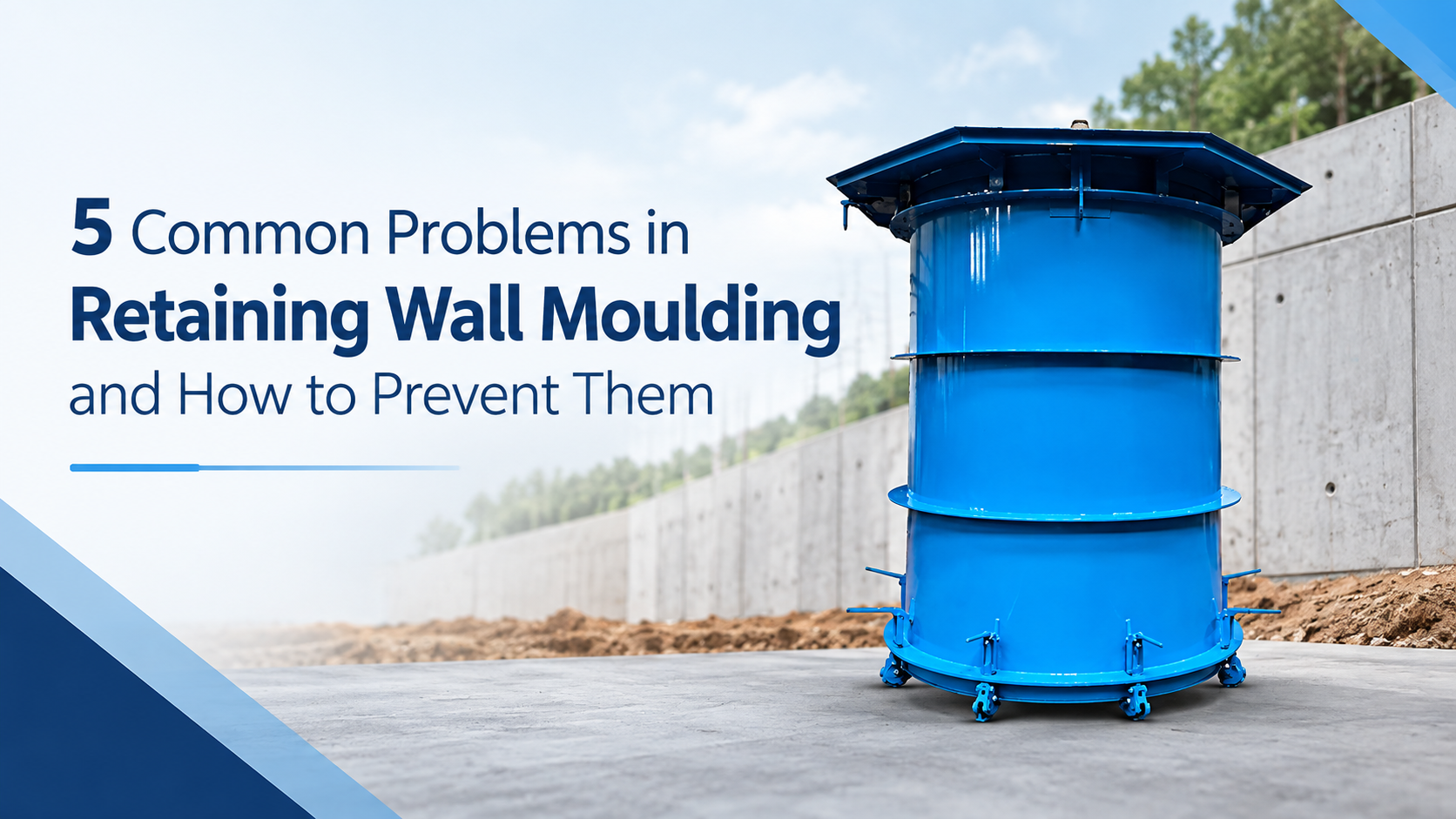
The applications of retaining walls consist of soil stabilization, slope stabilization, roads, drainage systems, and construction. However, for precast structures, the performance of the retaining wall once it has been constructed is greatly influenced by the molding. Improperly molded molds can lead to dimensional discrepancies, surface defects, displacement of the reinforcements, and problems during demolding.
Retaining Wall Moulds Suppliers like MS Industries can detect these issues early on and reduce material waste, rework, and delays in manufacturing.
Five Common Retaining Wall Moulding Problems and Practical Ways to Prevent:
1. Dimensional Variation in Finished Panels
Even small dimensional variations might lead to alignment issues while installing. The wall thickness, height, or edge shape may be inconsistent due to mould distortion, improper manufacture, or reuse without inspections.
Prevention:
- Sturdy moulds are made with precise dimensions.
- Inspection of mould shape prior to each manufacturing process.
- Appropriate support and clamping during the concrete pouring process.
- Mould inspections for deformations and wear should be done periodically.
Proper production requires cooperation with professional Retaining Wall Moulds Manufacturers that produce moulds with the required dimensions.
2. Concrete Leakage and Poor Edge Formation
Separation in the joints of the mold is one of the factors responsible for leaking of the cement slurry as a result of vibrations. It gives rise to honeycombing, weak edges, fins, and irregular surface finishes.
How to prevent it?
- Ensure that your joints remain straight.
- Always monitor seals, corners, and joints.
- Lock your mold well before casting.
- Too much vibration will result in excessive slurry flow.
If your mold is constructed well, your joints and geometry will be preserved.
3. Difficulty During Demoulding
Incompatible release agents can cause the concrete to adhere to the surface of the formwork. Aggressive removal can lead to damage to the concrete member and formwork.
Methods for preventing the problem:
- Employ an appropriate release agent suitable for the formwork material.
- Apply evenly without over-coating.
- Adhere to the recommended concrete curing period.
- Employ proper form removal technique rather than aggressive removal.
Appropriate use of release agent is especially important in repetitive formwork systems in mass precast production.
4. Surface Defects and Honeycombing
Presence of air gaps, voids, and uneven surfaces is common if the concrete is not well compacted or where the moulding design hinders vibration. Inconsistency in the concrete mix could be another cause of such defects.
How to prevent it:
- Maintaining consistent concrete mix quality.
- Using appropriate vibration techniques.
- Ensuring reinforcement does not obstruct concrete flow.
- Keeping mould surfaces clean before casting.
5. Premature Mould Wear and Reduced Production Efficiency
The molds undergo mechanical stresses because of their constant usage, vibration, wear from concrete, and stress during handling.
What can be done to avoid this problem?
- Clean moulds soon after casting.
- Handle the moulds carefully.
- Check joints, angles, and locking system frequently.
- Correct small defects to prevent any effect on castings.
Conclusion
Not only does the retention wall mould serve as the casting mould, but its importance lies in its ability to influence dimensional tolerance, surface finish, productivity, and uniformity of the part being produced. An optimum mould should be one that suits the wall design, concrete mix, reinforcement design, vibrations, and production cycle. Selecting the best Retention Wall Moulds Manufacturers for infrastructural projects or pre-casting would be useful when using professionals such as MS Industries.
Frequently Asked Questions:
1. Can you identify any cause that results in cracking of precast retaining walls?
Cracking may result from improper curing, stresses, lack of reinforcement, mix design, and early stripping.
2. How often should the molds used in making retaining walls be checked?
The molds need to be inspected before each casting, based on their intended use and production conditions.
3. Can the moulds for retaining walls be used repeatedly?
Yes. With careful design and maintenance of moulds, it is possible to perform several production cycles with accurate moulds.
4. Why are accurate moulds necessary for producing retaining walls?
They provide accurate measurements and quality finishes of the walls.